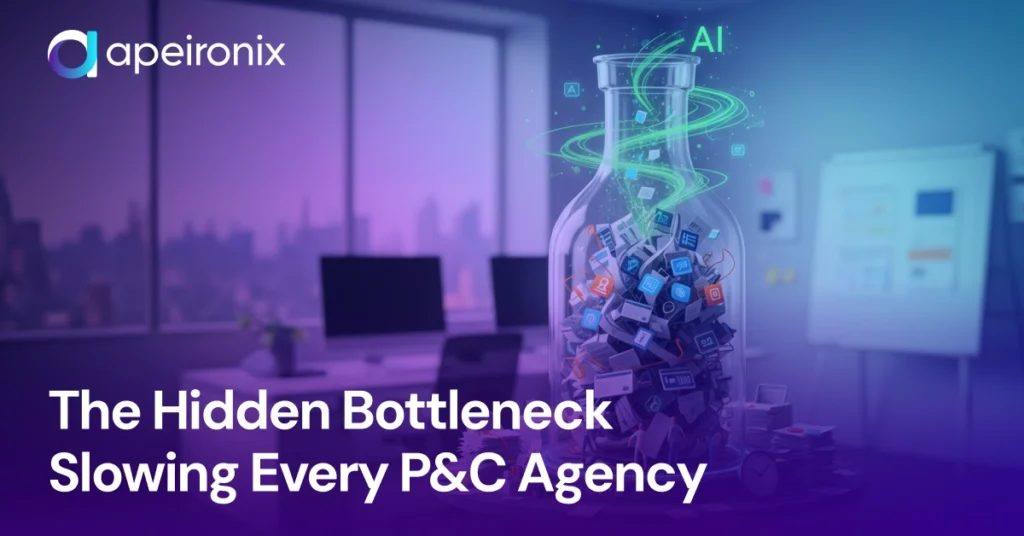
Most P&C agencies don’t have a talent problem.
They have a workflow problem.
Your team is busy all day, submissions moving, endorsements stacking up, renewals looming, but somehow the agency never quite gets ahead. Turnaround times stretch. Service teams feel maxed out. Producers spend too much time chasing updates instead of building relationships.
The issue isn’t effort. It’s friction.
Manual data entry. Re-keying the same information across carrier portals. Chasing loss runs. Copying details from ACORD forms into systems that don’t talk to each other. These small inefficiencies compound quietly, draining hours from every account and capping how much your agency can realistically handle.
For years, agencies tried to solve this by hiring more people or layering on more tools. That approach no longer works. Labor is expensive. Software stacks are already bloated. And adding complexity only increases the burden on the very teams you’re trying to support.
What’s changed is this:
AI is no longer an experiment, and it’s no longer built just for carriers or tech giants.
For the first time, AI can understand insurance documents, navigate carrier systems, and support real agency workflows without ripping out your existing AMS or retraining your entire staff. Used correctly, it doesn’t replace your people. It removes the repetitive work that slows them down.
This is where operational leverage finally becomes possible for agencies, not through bigger teams, but through smarter workflows.
Why Legacy Agency Tools Can’t Solve This Problem
Most agencies already have the tools they were told would fix efficiency.
An Agency Management System. Rating platforms. Carrier portals. Document storage. Maybe a workflow add-on or two layered on over time. Each system works well enough on its own, but none were designed to work together.
That’s the core issue
Legacy agency tools were built to store information, not to move work. They rely on people to act as the connective tissue, copying, pasting, re-entering, checking, and following up across systems that don’t speak the same language.
Every submission highlights the gap.
Data enters once, then gets touched again and again as it moves from ACORD to AMS to carrier portals to spreadsheets and back. Every handoff introduces delay, error risk, and fatigue.
Adding more software doesn’t fix this. In many cases, it makes it worse.
Each new platform brings another login, another workflow, another training requirement. Agencies end up hiring staff to manage systems rather than serve clients. Efficiency gains flatten while overhead keeps climbing
This is why incremental automation has stalled. Rule-based workflows and point solutions can handle isolated tasks, but they can’t adapt to the variability of real agency work, different carriers, different appetite rules, different submission requirements.
The result is a ceiling on growth.
Agencies hit a point where adding volume means adding headcount, and margins stop scaling. Not because teams aren’t capable, but because the infrastructure was never designed for operational leverage.
Fixing this problem requires more than better tools.
It requires a new layer, one that understands insurance work and can operate across the systems agencies already rely on.
Most Agencies Don’t Have a Technology Problem. They Have a Workflow Problem.
If your team is acting as the glue between disconnected systems, the issue isn’t effort, it’s infrastructure. Apeironix helps agencies remove friction by operating across the tools they already rely on.See how modern agencies are rethinking workflows at Apeironix.com
Why AI Is Finally Ready for Agency Workflows
For years, AI was talked about as a future promise for insurance, but it rarely delivered anything agencies could actually use.
Early tools struggled with unstructured documents. They couldn’t read ACORD forms reliably, interpret loss runs, or adapt to the nuance of carrier-specific requirements. Most “AI” features amounted to rules engines with better marketing.
That has changed.
Recent advances in document intelligence, large language models, and browser automation have unlocked something new: AI that can understand insurance information in the same formats’ agencies work with every day and operate inside real workflows.
This matters because agency work isn’t standardized. Submissions arrive incomplete. Carrier portals differ. Appetite guidelines shift. Processes vary by line, by carrier, and by client. Traditional automation breaks under that variability.
Modern AI thrives on it.
Instead of forcing agencies to restructure how they work, AI can now adapt to existing processes. It can extract data from submissions, follow carrier quoting steps, reconcile documents, and assist with downstream tasks, without requiring a rip-and-replace of your AMS or retraining your entire team.
Just as important, AI is no longer positioned as a replacement for people.
The most effective implementations treat AI as an augmentation layer, handling repetitive, time-consuming work so CSRs, producers, and operations teams can focus on judgment, relationships, and exceptions that actually require human expertise.
This shift marks a turning point.
AI has moved from a concept to an operational capability, one that finally aligns with how agencies actually function, not how vendors wish they did.
Where Agencies Lose the Most Time (And What Actually Fixes It)
Most agency leaders don’t need a report to tell them where time disappears. They see it in backlogs, delayed quotes, and teams constantly switching contexts.
The biggest drains tend to show up in the same places.
Submission intake is the first choke point. Information arrives incomplete, inconsistent, or buried in attachments. Teams spend valuable time reviewing forms, tracking missing details, and re-entering data into multiple systems before work can even begin.
Loss runs and supplemental documents create another bottleneck. Requests go out, follow-ups pile up, and staff chase files that arrive in different formats and require manual review before they’re useable.
Quoting across carrier portals multiplies the problem. Each portal has its own workflow, data fields, and quirks. Even experienced staff are forced into repetitive copy-paste cycles that add no value and invite errors.
Renewal preparation and remarketing compound everything. Accounts are touched repeatedly, often under time pressure, with little consistency across producers or service teams. Work becomes reactive instead of planned.
Policy servicing and endorsements extend the cycle. Small changes require multiple system updates, checks, and confirmations, tasks that consume time far out of proportion to their complexity.
None of this work is inherently difficult.
It’s repetitive, fragmented, and unnecessary.
What fixes it isn’t another checklist or training session. It’s removing the manual handoffs altogether.
When data can be extracted, validated, and moved automatically between systems and when routine steps can be executed without constant human intervention, work flows instead of stalls. Teams regain focus. Turnaround improves. Capacity expands without adding headcount.
This is where AI delivers real value: not in replacing judgment, but in eliminating the friction that prevents judgment from being used where it matters most.
AI as the Missing Workflow Layer Inside the Agency
The real power of AI in an agency environment isn’t speed on a single task; it’s continuity across the entire workflow.
For decades, people have been the bridge between systems. They move information from submissions to the AMS, from the AMS to carrier portals, from portals to spreadsheets, and back again. That manual coordination is what slows agencies down and limits scale.
AI changes that by becoming the connective layer.
Instead of asking your team to adapt to yet another platform, AI operates across the tools you already use. It can read incoming documents, extract and normalize data, and carry that information forward through each step of the process, without requiring constant human intervention.
This doesn’t eliminate roles. It sharpens them.
Customer service teams spend less time re-keying and more time resolving exceptions. Producers gain visibility and responsiveness without chasing updates. Operations leaders get consistency without enforcing rigid processes that frustrate experienced staff.
Most importantly, AI standardizes execution without flattening expertise.
Agencies often struggle to scale because workflows live in people’s heads. When key team members are out, productivity dips. When volume spikes, quality slips. AI-supported workflows create stability by handling the routine work the same way every time, while still escalating judgment calls to the right people.
The result is an agency that runs smoother, not because it’s automated for automation’s sake, but because friction has been intentionally removed.
This is the shift from labor-bound growth to leverage-driven growth.
What Changes When Manual Work Disappears
When repetitive work is removed from the workflow, agencies don’t just get faster, they get fundamentally better.
Turnaround times improve first. Submissions move through the pipeline without stalling at every handoff. Quotes come back sooner. Endorsements stop lingering in queues. Clients notice the difference immediately, even if they never see the technology behind it.
Capacity expands next. When CSRs and account managers aren’t buried in data entry and follow-ups, they can handle more accounts without burning out. Producers spend less time chasing status updates and more time advising clients and closing business. Growth no longer requires a proportional increase in headcount.
Consistency follows. Work is done the same way every time, regardless of who initiates it. Fewer steps are missed. Errors decline. Renewals become predictable instead of chaotic. Institutional knowledge is no longer trapped in individual inboxes.
Morale improves along the way. Teams stop feeling like they’re drowning in low-value tasks. Roles feel more professional, more sustainable, and more aligned with why people chose this industry in the first place. That stability reduces turnover and protects hard-earned expertise.
And critically, leadership gains visibility. When workflows are streamlined and measurable, agency owners and operators can see where time is going, where bottlenecks still exist, and where to focus next. Decisions shift from reactive to intentional.
None of these gains come from working harder.
They come from removing the work that never should have been manual to begin with.
What Would This Look Like Inside Your Agency?
Every agency’s workflows are different, but the friction points are often the same. Apeironix is designed to adapt to real agency processes, not force teams into rigid templates.
Explore how AI fits into agency workflows at Apeironix.com
Measuring What Actually Matters to Agency Owners
Efficiency only matters if it shows up in the numbers.
For agency owners, success isn’t measured by how many tools are deployed or how modern the tech stack looks. It’s measured by throughput, margin, and the ability to grow without constantly adding headcount.
When manual work is reduced, the right metrics start to move quickly.
Submission-to-quote cycle time shortens. Faster turnaround improves win rates and strengthens carrier and client relationships. It also reduces internal pressure on service teams juggling competing priorities.
Touches per account decline. Each time a human has to touch a file, cost is introduced. Fewer touches mean lower servicing expense and fewer opportunities for errors or rework.
CSR utilization becomes clearer. Instead of measuring activity, agencies can measure capacity, how many accounts a team can support effectively without burnout. This makes staffing decisions more strategic and less reactive.
Renewal throughput stabilizes. With fewer last-minute scrambles and more predictable workflows, renewal seasons become manageable instead of disruptive. That consistency protects both revenue and morale.
Error rates and rework fall. Manual entry and handoffs are the primary sources of mistakes. Removing them reduces E&O exposure and downstream cleanup work that rarely shows up on a time sheet but always impacts margins.
These metrics tell a different story than traditional reports. They show whether the agency is building leverage, or simply staying busy.
When agency leaders can see these numbers clearly, they gain control. Decisions about hiring, pricing, and growth become grounded in operational reality instead of instinct.
That visibility is what turns efficiency into a competitive advantage.
Avoiding the Traps: Where Agencies Go Wrong with AI
AI can deliver real leverage for agencies, but only when it’s applied with discipline.
The most common mistake is over-automation. Not every task should be automated, and not every decision belongs to a machine. Agencies get into trouble when they try to replace judgment instead of removing friction. The goal is to free people to make better decisions, not to eliminate human involvement entirely.
Another pitfall is poor data hygiene. AI systems are only as effective as the information they work with. Inconsistent naming conventions, incomplete submissions, and outdated records create downstream issues if they aren’t addressed early. Successful agencies treat clean data as a prerequisite, not an afterthought.
Security and governance are often underestimated. Agency data is sensitive, and AI tools must be designed with clear access controls, auditability, and compliance in mind. Introducing automation without understanding where data flows, or who can see it, creates risk that outweighs efficiency gains.
Many agencies also struggle by buying tools without workflow integration. Point solutions that automate a single step but don’t connect to the broader process often increase complexity instead of reducing it. When teams are forced to jump between systems, the promised efficiency never materializes.
Finally, agencies sometimes fail to bring their teams along. Even the best technology stalls if staff don’t understand how it supports their work. Change management matters, not through heavy training programs, but through clear communication and gradual, visible wins that build confidence.
Agencies that succeed with AI move deliberately. They test, measure, adjust, and expand only when value is proven. That approach reduces risk while ensuring innovation actually delivers results.
What the Next 12–24 Months Will Mean for Agencies
The gap between efficient agencies and everyone else is widening and it won’t close on its own.
Client expectations are rising. Faster responses, clearer communication, and smoother onboarding are becoming table stakes. Agencies that can’t keep pace will feel the pressure first in retention, then in pricing power.
Carriers are tightening standards as well. Appetite shifts, data requirements, and turnaround expectations are increasing. Agencies that operate efficiently become easier partners. Those that don’t absorb the friction internally, often at the expense of their teams.
Meanwhile, labor constraints aren’t easing. Hiring experienced talent remains expensive and unpredictable. Training new staff takes time agencies no longer have. Growth strategies built on adding headcount will continue to strain margins.
What’s emerging is a clear divide.
Agencies that modernize their workflows gain leverage. They scale service without scaling stress. They protect institutional knowledge. They create consistency that clients and carriers can rely on.
Agencies that delay modernization don’t necessarily fail overnight, but they stagnate. Work gets harder. Renewal seasons grow heavier. Margins tighten. Eventually, opportunity costs outweigh the comfort of staying the same.
The next 12 to 24 months will define which agencies are positioned to grow and which are simply trying to keep up.
The difference won’t be vision.
It will be execution.
Conclusion: The Agencies That Win Will Remove Friction First
Every agency wants to grow. Very few want to grow harder.
The agencies that win in the next phase of the market won’t be defined by how many people they hire or how many tools they buy. They’ll be defined by how effectively they remove friction from the work their teams do every day.
Manual processes, disconnected systems, and repetitive tasks don’t just slow agencies down, they cap what’s possible. They turn experienced professionals into data movers and limit growth to the pace of human throughput.
AI changes that equation, but only when it’s applied intentionally.
When automation is used to eliminate low-value work, agencies gain leverage. Teams regain focus. Capacity expands without burnout. Consistency improves without sacrificing judgment. And leadership finally gets visibility into how work moves across the organization.
This isn’t about replacing people.
It’s about letting them do the work that actually matters.
Agencies that act now will build durable advantages, operationally, financially, and culturally. Those that wait will continue fighting the same constraints, just with higher costs and tighter margins.
The future of agency growth isn’t more effort.
It’s less friction.
How Apeironix Turns AI Into Agency Leverage
Apeironix was built specifically for insurance agencies, not as another system to manage, but as an automation layer that operates across the tools you already use.
We help agencies:
- Eliminate repetitive, manual work across submissions, quoting, renewals, and servicing
- Reduce touches
- per account without disrupting existing processes
- Improve turnaround times while protecting quality and compliance
- Scale capacity without scaling headcount
- Modernize workflows without ripping out your AMS
Our focus isn’t AI for demos.
It’s AI that works inside real agency operations.
If you’re ready to see what friction-free workflows look like in practice, we’re ready to show you.Explore how Apeironix supports modern agencies at Apeironix.com